Centralized or decentralized. Existing facility or greenfield. Modular cells, one architecture.
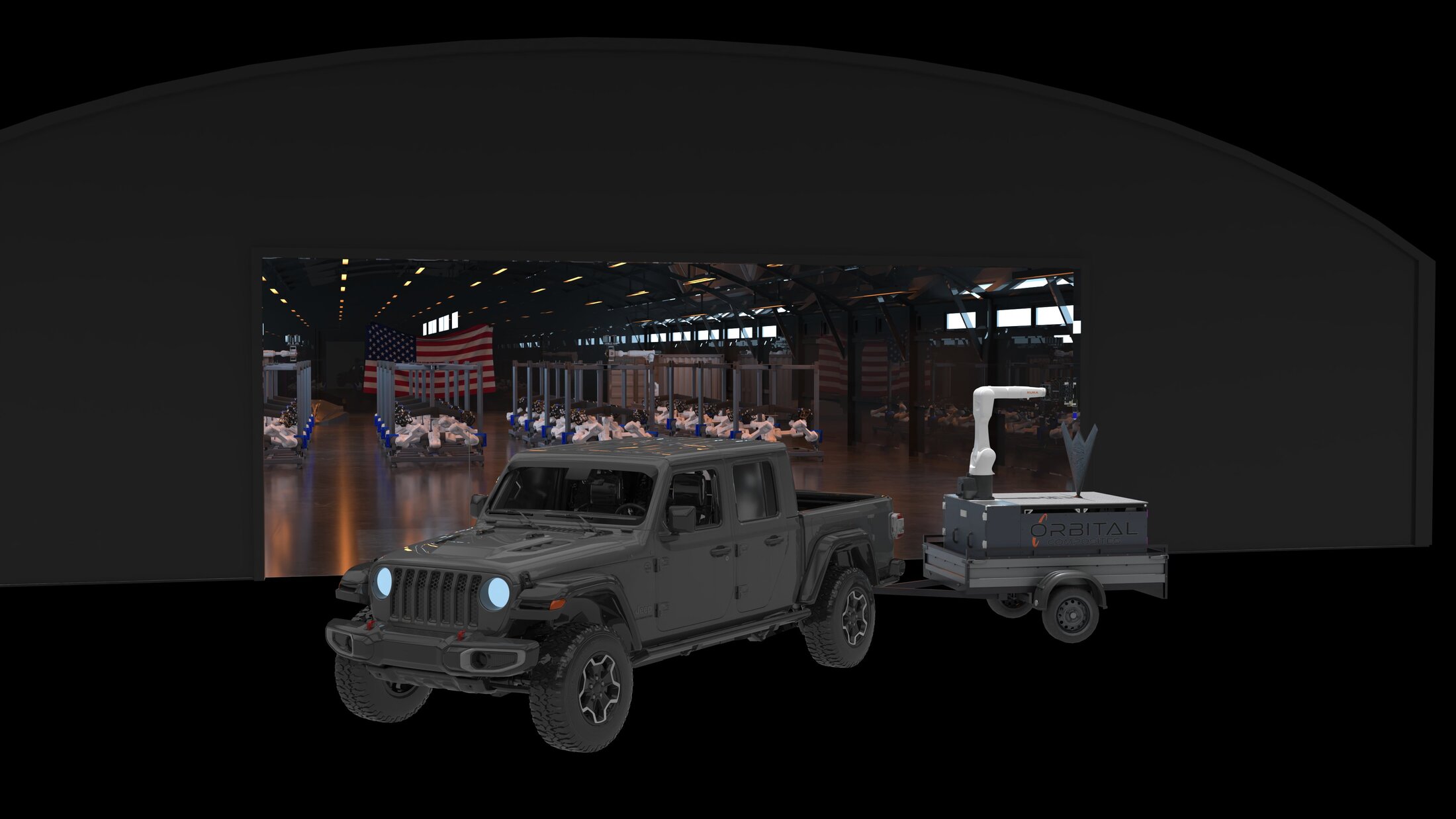
The factory for advanced composites doesn't have to be a fixed installation. Orbital's architecture is cellular: each cell is a self-contained production unit, and the factory is a network of cells.
That architecture decouples production from place. Existing facility? Install cells into the building you have. Forward base? Deploy cells to where the mission is. Greenfield site? Stand up a purpose-built Orbital facility. Centralized or decentralized, at any scale the mission demands.
The two core capabilities inside every cell — multi-robot coordination and continuous-fiber printing — were pioneered here. Orbital was the first to bring coordinated multi-robot continuous-fiber composite manufacturing to production scale, protected by issued patents across the technology stack. A decade of applied work with national labs and defense agencies proved the technology in mission-critical applications.
Orbital operates a production facility today — and the same architecture deploys anywhere a customer needs it.
↳ Modular · Deployable · Scalable · Software-defined
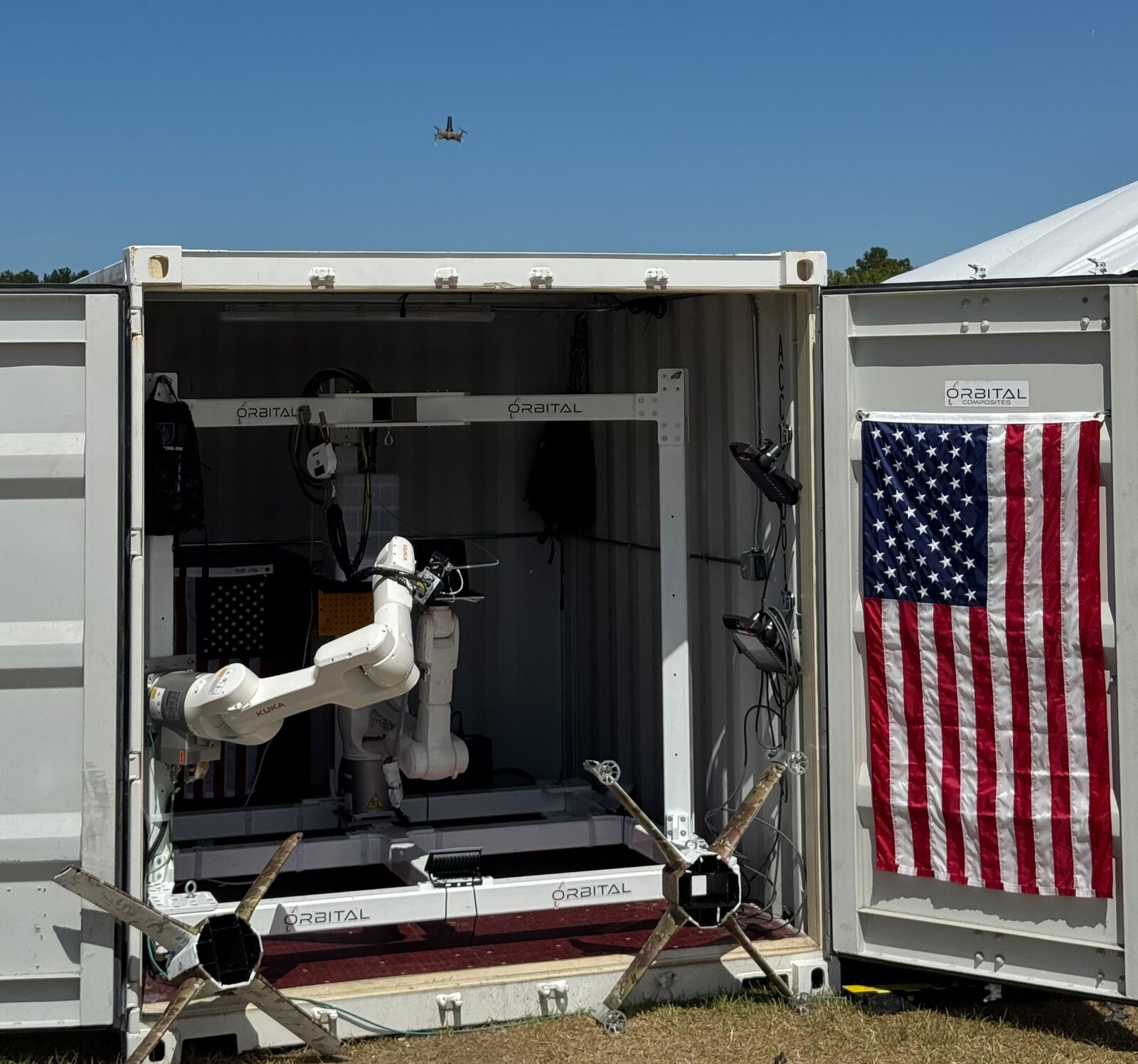
Orbital cell deployed in the field. Composite drone airframe in the foreground. Drone in flight overhead. The deployable-cell thesis is not a render — it's operating.
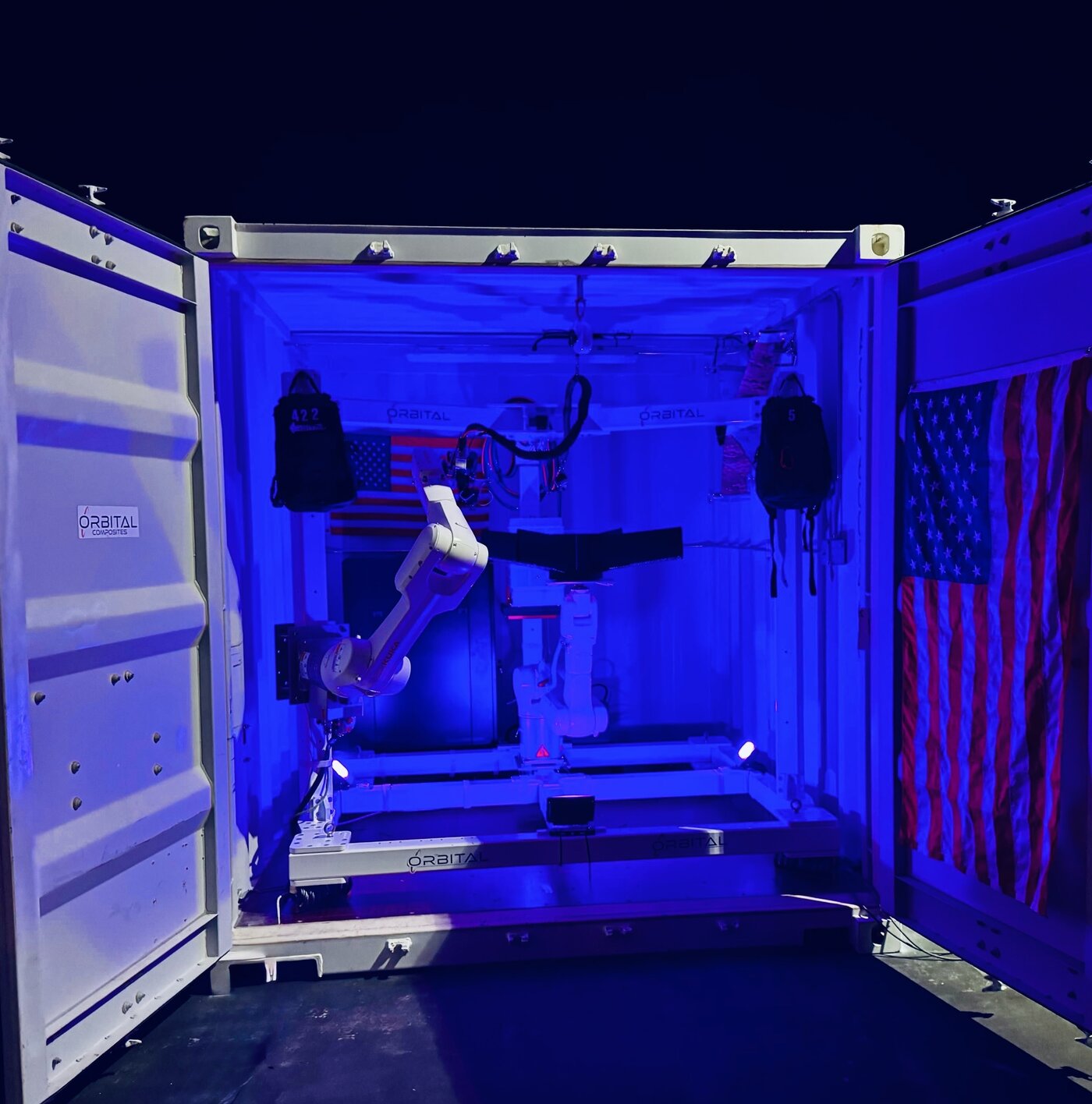
A single-robot production cell is a well-understood problem. Two robots sharing a workspace is not — and composite manufacturing demands more than two. Path planning, collision avoidance, synchronized deposition, and real-time correction all have to work together, continuously, at production rate.
Solving multi-robot coordination for composites isn't a software problem or a hardware problem. It's a controls problem, a kinematics problem, a materials problem, and a manufacturing problem — all at once. Most of the industry treats multi-robot systems as expensive research apparatus. Orbital treats them as the basic unit of production.
Orbital built the technology stack that makes coordinated multi-robot composite manufacturing work at rate — the kinematics, the deposition control, the sensor fusion, the process loop. It is the foundation everything else is built on.
↳ Coordinated motion · Synchronized deposition · Production-rate controlMost additive manufacturing uses chopped fiber or unreinforced polymer. The resulting parts are fast to produce but weak — suitable for prototypes, not primary structures. Conventional composite layup produces strong parts but slowly, manually, and in limited geometries.
Continuous-fiber printing combines the speed of additive manufacturing with the structural performance of continuous-fiber composites. Fibers are placed along the load paths that the design demands — not interrupted, not chopped, not compromised. The result is parts with the strength-to-weight performance of traditional composites, produced at rates traditional composites cannot approach.
Orbital developed continuous-fiber printing as a production technology — the process control, the fiber handling, the resin chemistry, the inspection loop. It's the material science that unlocks rate production of structural composites: drone airframes, missile structures, satellite buses, and reactor components, all produced in the same cell, on the same day, at production cost.
↳ Load-path fiber placement · Structural-grade parts · Rate productionAdditive manufacturing gets you geometry. Compression molding gets you rate. AMCM is how Orbital produces composite parts that need both.
For the highest-rate production, pure additive manufacturing has a ceiling. Layer-by-layer deposition is inherently sequential, and at consumer-electronics or mass-defense volumes, the minutes per part matter. Orbital's AMCM process prints a composite near-net preform, then transfers it into a compression mold for final consolidation — combining the geometric freedom of additive with the throughput and consolidation quality of compression molding.
The result is parts produced at rates pure additive cannot approach, with void-free consolidation and surface finish that match injection-molded composites — while still benefiting from the continuous-fiber reinforcement, load-path fiber placement, and design agility that only additive provides.
AMCM is the production path for Orbital's highest-volume applications — drone airframes, interceptor structures, and any part class where unit cost and rate decide whether the program is viable. The process is piloting today at Orbital — demonstrated in production, not yet at full rate.
↳ Print the preform · Mold to finish · Rate + geometry in one flow · PilotingOrbital's platform scales. The same core technology — multi-robot coordination, continuous-fiber printing — is delivered in cells sized to the parts they produce. Smaller components at rate, or large-format aerospace structures, on the same architecture. Ready to install in an existing facility, integrate into a purpose-built Orbital factory, or deploy to a forward site.
Precision composite production, in a 10-foot footprint.
Multi-arm coordinated robotic systems, face-to-face, inside a 10-foot container. Optimized for smaller structural composites at rate — drone airframes, CubeSat structures, propulsion subsystems, missile structural components. Self-contained and deployable: install in an existing facility, array multiple units inside a purpose-built Orbital factory, or ship to a forward site as production infrastructure.
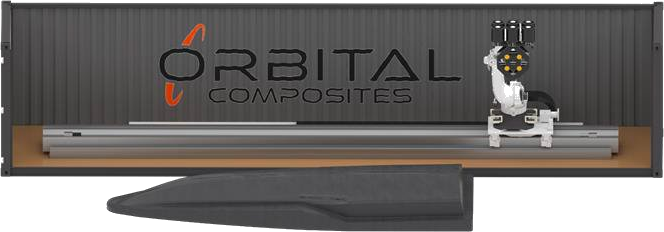
Large-format composites on a rail-based gantry.
A 40-foot container with a rail-mounted multi-axis printing head traversing its full length. Purpose-built for large-format and elongated composite structures — missile bodies, launch vehicle components, reentry vehicles, satellite bus platforms, reactor-scale structural parts. Same continuous-fiber printing capability as Orbital S, applied at aerospace-primary-structure scale.
Every Orbital cell is software-defined and instrumented for closed-loop process control. Every cell produces structural composites with continuous-fiber reinforcement. Every cell deploys anywhere the mission requires — and new scales of the platform can be built as the applications demand them.
↳ Orbital S · Orbital F · Production-ready · More scales aheadOne platform.
Any scale the mission demands.